
WeRide's AI slashes token costs by 98%
PLUS: Japan's $2.3B physical AI venture, Agility's 200-engineer hiring spree, and Eric Trump's lethal humanoid project

Welcome back to your Robot Briefing
WeRide just announced a foundation model built entirely on physical-world facts instead of internet text, claiming it slashes token costs by 98% and processes data 200 times faster than general-purpose AI.
If physical AI models can genuinely train on verifiable facts rather than scraped web data, does that finally solve the hallucination problem that's kept robots out of high-stakes environments? The implications for autonomous systems could reshape how companies approach AI deployment entirely.
In today's Robot update:
Autonomous driving leader WeRide unveils fact-based foundation model for physical AI
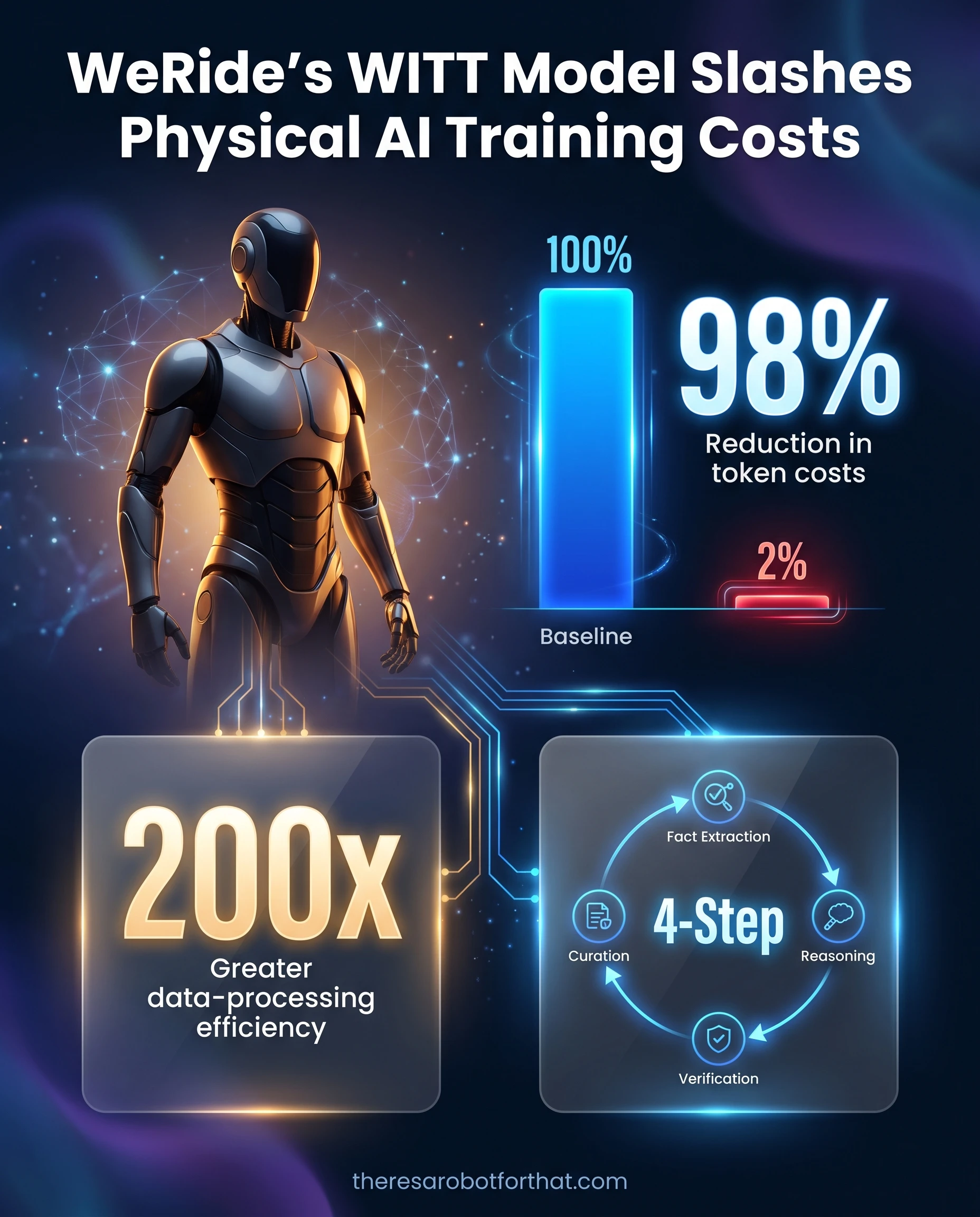
Image Source: There's A Robot For That
Snapshot: WeRide, the autonomous vehicle company now public on NASDAQ and HKEX, just launched WITT, a foundation model claiming 98% lower token costs and 200x greater data-processing efficiency than general-purpose AI models by anchoring AI training to verifiable physical-world facts instead of internet text.
Breakdown:
Takeaway: The efficiency claim matters if it holds: training costs are a major barrier to deploying AI in industrial robotics, and a 98% reduction would fundamentally change ROI math for companies hesitant to invest. If you're evaluating robotics vendors this year, ask whether their models train on real operational data or simulated environments. The former is becoming the credibility benchmark.
Japanese tech giants form Noetra with Nvidia to develop $2.3B physical AI foundation model
Snapshot: $2.34 billion just moved into physical AI development as Sony, SoftBank, NEC, Honda and other Japanese firms jointly established Noetra, backed by Japan's industry ministry with a five-year plan to invest $6.15 billion total through 2030, partnering with Nvidia for computing infrastructure.
Breakdown:
Takeaway: When a national government commits $6 billion over five years to a specific technology category, that's a forcing function for the entire supply chain. Expect Japanese robotics vendors to gain pricing leverage and capabilities faster than their balance sheets alone would suggest, and for procurement conversations in global manufacturing to shift as state-backed competitors change the cost curve.
Agility Robotics opens Silicon Valley AI hub, hiring 200 for humanoid development push
Snapshot: Everyone builds demos. Agility Robotics just opened a 59,900 square-foot AI development center in Fremont and is hiring 200 software engineers to accelerate development of its Digit humanoid, which already has $300 million in multi-year orders and deployments at Schaeffler, GXO, Toyota Canada, and MercadoLibre.
Breakdown:
Takeaway: The signal here isn't the facility itself. It's that a robotics company is scaling hiring and infrastructure to fulfill backlog, not to chase venture funding. If you oversee warehouse or manufacturing operations and haven't modeled labor cost scenarios that include humanoids, your peers already have.
Eric Trump-backed startup targets lethal humanoid robots for military deployment
Snapshot: Foundation Future Industries, the humanoid startup that counts Eric Trump as both investor and chief strategy adviser, told WIRED it plans to give its robots lethal capabilities within months, with CEO Sankaet Pathak describing "kinetic things we're exploring" and the company already testing its Phantom MK1 humanoid with Ukrainian forces.
Breakdown:
Takeaway: This raises the question commercial robotics buyers haven't had to answer yet: does sourcing humanoid technology from vendors with parallel military contracts create supply chain, reputational, or regulatory risk for non-defense deployments? The line between dual-use robotics and purpose-built military systems is blurring faster than procurement policies are adapting, worth surfacing with your legal and compliance teams before vendor shortlists get finalized.
Other Top Robot Stories
Galaxy plans to establish a global Physical AI entertainment platform supplying emotion, character, fashion and K-content to humanoid robots worldwide, demonstrated with three robots performing synchronized K-pop choreography at the UN's AI for Good Global Summit 2026 in Geneva.
Georgia developed a faster, cheaper machine learning method to train whole-body controllers for bipedal humanoid robots, successfully deploying it on a two-legged robot that navigated sand, gravel, grass, slopes and stairs without those surfaces being included in training simulations.
Humanoid employs a four-layer AI architecture from fleet coordination to whole-body control in its wheeled HMND 01 robot, prioritizing industrial applications with strategic partnerships from Bosch and Schaeffler as the UK-based firm positions for rapid European manufacturing growth.
Intuitive fell 35% from its all-time high despite beating Q2 earnings expectations, with RBC Capital maintaining an Outperform rating as the surgical robotics leader reported 11,395 da Vinci systems installed globally, up 12% year-over-year, while procedures jumped 17%.
Deploying humanoids this year? Our free Facility Readiness Checklist walks your site before the robot arrives, 77+ items, one complete toolkit module.
🤖 Your robotics thought for today:
WeRide claims 98% lower token costs. Agility has $300 million in actual orders. Japan just committed $6 billion over five years. The pattern isn't subtle: physical AI stopped being a research problem and became a procurement decision. Companies signing multi-year contracts aren't waiting for the technology to mature. They're betting their 2027 labor budgets that it already has.
I'm watching how many of those orders convert to renewals.
Until Wednesday,
Uli


