
XPENG to mass-produce humanoids by year-end
PLUS: Hugging Face's $2,500 open-source robot legs, BMW deploys humanoids in Germany, and AWS backs 100-robot training facility

Welcome back to your Robot Briefing
Chinese EV maker XPENG is betting it can replicate its car manufacturing playbook with humanoid robots, targeting mass production by late 2026 and retail deployment shortly after.
Rephrase to clarify the exact year of the automotive ramp or remove the 'eight years ago' reference if it's not crucial for the current timeline.
In today's Robot update:
Chinese EV maker XPENG targets humanoid mass production by year-end
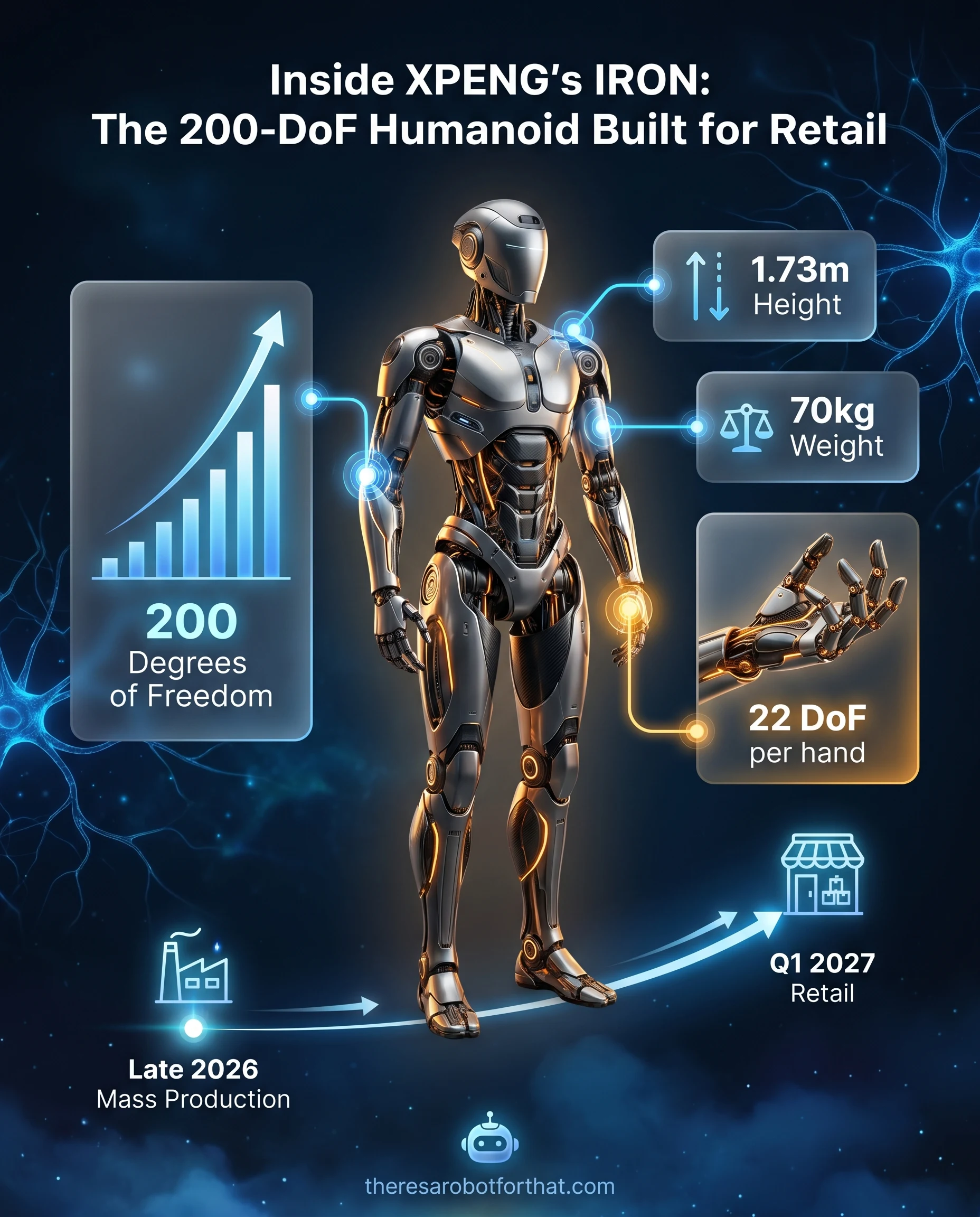
Image Source: There's A Robot For That
Snapshot: Chinese electric vehicle manufacturer XPENG is targeting mass production of its IRON humanoid robot by end of 2026, with commercial deployment as retail store assistants starting Q1 2027. The company's CEO drew a direct parallel to XPENG's automotive mass production timeline eight years ago, signaling a transition from validation to serial manufacturing.
Breakdown:
Takeaway: XPENG's 2027 retail deployment timeline offers a concrete benchmark for when humanoid robots transition from pilot to commercial service roles — not in factories or homes, but in customer-facing environments where labor economics justify the investment. Companies evaluating automation should note that even well-funded players are targeting narrow service applications first, not broad industrial replacement.
Hugging Face releases $2,500 open-source humanoid robot legs
Snapshot: AI platform Hugging Face launched LeRobot Humanoid, a $2,500 3D-printable bipedal robot platform with full assembly instructions, bill of materials, and software tools for calibration and control. The release aims to democratize robotics research by providing affordable, repairable hardware that enables testing AI software in physical robots rather than simulation alone.
Breakdown:
Takeaway: The $2,500 price point and open-source approach signal that robotics development infrastructure is becoming accessible beyond major corporate labs, potentially accelerating software innovation even if the hardware remains limited. Operations leaders should recognize this as a talent development signal — universities and smaller teams can now train on physical robots, expanding the pipeline of engineers who understand real-world deployment challenges.
BMW expands humanoid deployment from US to Germany production
Snapshot: BMW is moving humanoid robots from its Spartanburg pilot to production environments in Germany through a new Physical AI initiative at Plant Leipzig, establishing a "Center of Competence for Physical AI in Production" to consolidate robotics expertise. The expansion follows successful testing of Figure AI's Figure 02 robot handling sheet-metal parts in chassis assembly workflows.
Breakdown:
Takeaway: BMW's shift from pilot to production deployment and dedicated organizational structure indicates humanoids are entering the "early deployment" phase for specific manufacturing workflows, not broad factory automation. Manufacturing operations leaders should focus on identifying similarly narrow use cases — repetitive, physically demanding material handling in semi-structured environments — where traditional automation falls short and labor costs justify the investment.
AWS-backed startup runs 100-robot training facility in Boston
Snapshot: Tutor Intelligence operates Data Factory 1 in Watertown, Massachusetts, with 100 humanoid robots learning through trial-and-error and VR-guided demonstrations from remote operators worldwide. The facility addresses the fundamental challenge that unlike language models trained on internet text, physical AI lacks sufficient training data for real-world manipulation tasks.
Breakdown:
Takeaway: The 100-robot training facility reveals that data generation — not just hardware or algorithms — is the current bottleneck for physical AI, similar to how language models required massive text datasets. Companies evaluating robotics vendors should ask not just about robot capabilities, but about training data quality and scale, as this infrastructure layer will likely determine which providers can actually deliver reliable performance in variable real-world conditions.
Other Top Robot Stories
Rotaku launched Domo, a $2,999 humanoid robot with whole-body policy learning that lets developers teach tasks through demonstration rather than code, targeting researchers and smaller robotics teams who've been priced out by six-figure platforms.
China assigned unique 29-character digital identity codes to over 28,000 humanoid robots across 200 models from 100+ manufacturers, creating a national tracking system that monitors robots from production through recycling under the Ministry of Industry and Information Technology.
FANUC showcased physical AI-enabled industrial robots at Automate 2026, featuring NVIDIA Jetson-powered processing and real-time adaptive motion that lets robots perceive environments and make decisions without pre-programming across manufacturing applications.
Shanghai opened China's first heterogeneous humanoid training facility in July, hosting 100+ robot types from a dozen companies across 5,000 square meters where diverse models train on shared tasks to build a large-scale learning database for faster future adaptation.
🤖 Your robotics thought for today:
XPENG is mass-producing humanoids for retail stores while BMW moves them into German factories. Hugging Face just made robot legs printable for $2,500. Three completely different deployment strategies, three different price points, three different bets on what works first. I'm watching which timeline breaks first — the EV maker's 2027 retail assistants or the automaker's production floor expansion.
Enjoy your weekend,
Uli


